Collection layer
Chrome extension (Manifest v3) captures product pages from major Korean commerce sources and posts to the collect API; per-platform identifiers drive group-level deduplication; 2.19M collection jobs, 7.88M items to date.
CODOT · WONJU, KOREA · COMMERCE AUTOMATION R&D
Codot builds the AI that turns product sourcing, content generation, marketplace listing, and order operations into a single data pipeline. Our platform, SellingMate, is a web + Chrome-extension SaaS with 465 API endpoints, 7 job queues, and a stack of AI engines — salient-object segmentation, neural rendering, retrieval-grounded structuring, and demand forecasting — running in production at more than a million products a month.
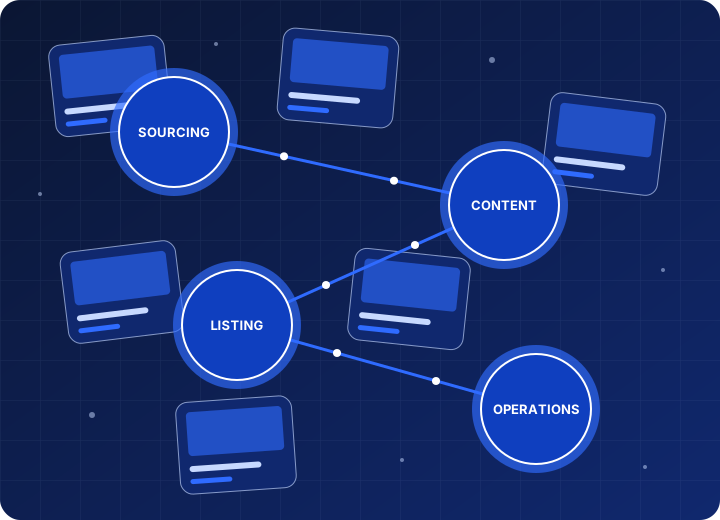
In production · 1M+ products processed every month
The problem
A marketplace listing is 20–30 structured fields, each governed by rules that differ per marketplace and change without notice. Getting one wrong hides the listing or suspends the account. At hundreds of products a day this is not a labor problem — it is a data-structuring and rule-learning problem, and that is the problem Codot is built to solve.
Architecture
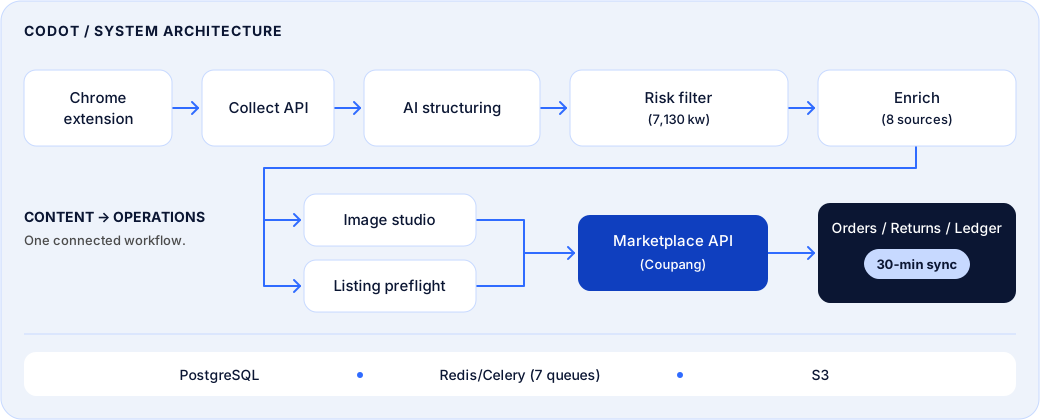
Chrome extension (Manifest v3) captures product pages from major Korean commerce sources and posts to the collect API; per-platform identifiers drive group-level deduplication; 2.19M collection jobs, 7.88M items to date.
Transformer-based attribute extraction grounded by retrieval over the marketplace rule corpus (RAG on ChromaDB) turns titles, options, and specs into a listing-ready schema; CJK attribute names are mapped through a learned display dictionary; a GTIN cache validates check digits and string similarity. Average 2.16 s per item.
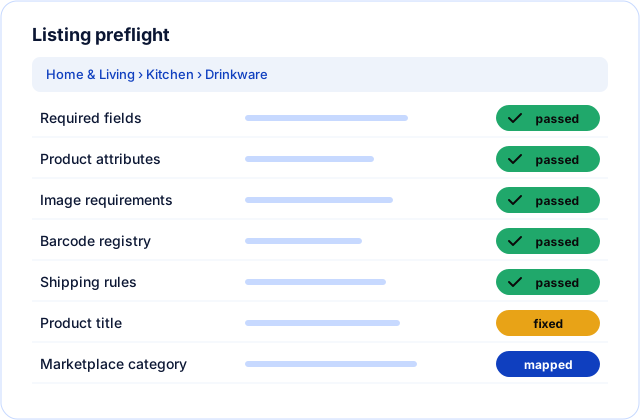
Marketplace rules are stored as data (7,130 blocked keywords, 168 blocked categories) and embedded for retrieval; a hierarchical category classifier proposes categories and self-corrects from rejection feedback; preflight validates every field, replaces banned terms, and enriches from 8 external sources. 2.19M listing mappings, 1.78M successful.
Adaptive scheduler syncs orders every 60 minutes and returns on a configurable cycle; 30,583 return requests handled; 2.24M double-entry ledger rows; team roles and permissions.
Celery on Redis · 7 queues (default, uploads, removebg, vendor_recheck, meta_preflight, collect, deletes) · 14 routed task types · late-ack, prefetch 1 · adaptive scheduler with stale-job sweeps
AI engines
| Engine | Modality | Stage | Next milestone | Volume to date |
|---|---|---|---|---|
| Background removal | Salient-object segmentation, U²-Net family cascade | Production (Aug 2025) |
On-prem GPU inference (2027) | 672K images, peak 110K/month |
| Attribute extraction & structuring | LLM + retrieval-grounded rules (RAG / ChromaDB) | Production (Jul 2025) |
Multilingual attribute schema | 4.07M products |
| Listing preflight & category mapping | Hierarchical classifier + rule engine | Production |
Self-correcting category mapping v2 | 191K checks, 66K enrichments |
| Generative image studio | Diffusion models + NeRF view synthesis | Production (2025) |
Batch generation, brand presets | 4,337 images, 94 templates |
| Sales prediction & recommendation | LSTM sequence models + gradient-boosted ranking | Production (2025) |
Recommendation API for partners | Trained on 4.07M products / 213K orders |
| 3D product twins | Neural rendering (3D Gaussian splatting) | In development |
Multi-view capture → 360° product assets (2027) | Multi-view capture pipeline in progress |
| Commerce data platform | Data platform | In development |
Partner data API (2027) | Schema and access model in design |
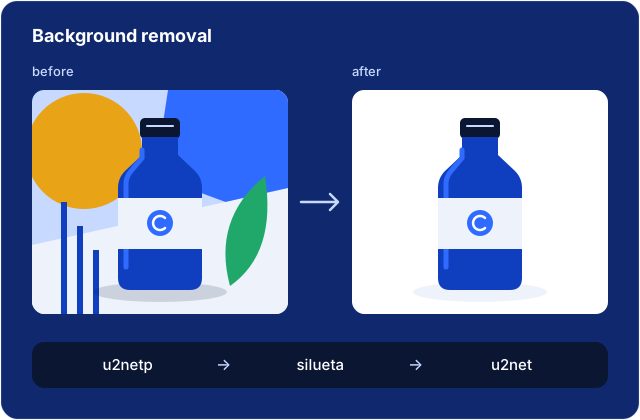
A U²-Net family cascade (u2netp → silueta → u2net) with in-process session caching, followed by OpenCV post-processing: badge suppression, alpha-matte edge refinement, white-background compositing, and marketplace-spec 1,000 px resize. 672K images, peak 110K a month.
Marketplace rules are embedded and retrieved (RAG over ChromaDB) so the model structures each field against the current rule set; a hierarchical category classifier proposes categories, validates them against 168 blocked nodes, and self-corrects from rejection feedback. 191K preflight runs, 66K enrichment jobs.
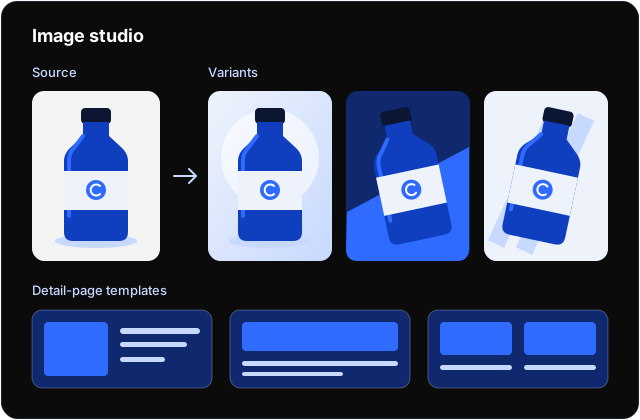
Product photos become new angles through neural radiance field (NeRF) view synthesis and diffusion-based background generation; template-conditioned prompts fix subject, lighting, and 3/4 view, and 94 detail-page templates assemble the output. 81 batch jobs, 4,337 images.
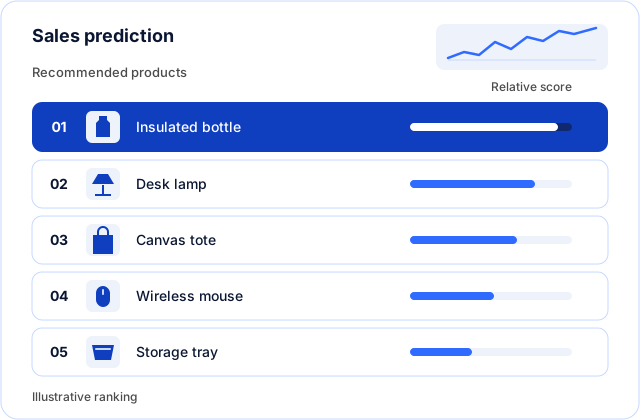
LSTM sequence models and gradient-boosted ensembles over 4.07M products and 213K orders, with engineered price, category, and listing-age signals, learning what listed products actually sold. In production since 2025, recommending what to list next; accuracy improves as sales data accumulates.
Data
Every listing, order, and return flows back into the same database, so the forecasting models train on ground truth the platform itself produced — a closed data loop that also feeds the rule corpus and the category classifier.
| Month | Collected | Listed | Background-removed |
|---|---|---|---|
| Mar 2026 | 1.03M | 550K | 94K |
| Apr 2026 | 1.17M | 520K | 93K |
| Jul 2026 | 1.25M | 930K | 110K |
| Aug 2026 | 0.99M | 800K | 67K |
Research & recognition
Deep-learning and time-series research by Codot's founding team.
Software-defect classification with ensemble ML, by Codot's founding team.
Codot's research unit for commerce AI.
Operational data behind attribute extraction and sales prediction; the basis for joint-research proposals.
2025 – present
Every engine is proven on real seller accounts before it is called done.
Old clients are retired automatically so the entire fleet runs the current collector within hours.
Listings, orders, and returns feed the forecasting models continuously.
Infrastructure & security
Images on S3 with server-side encryption (AES-256 or KMS).
PostgreSQL; logical backups encrypted with AES-256-CBC + PBKDF2, production guarded.
Redis-backed Celery, JSON serialization, late acknowledgement, prefetch 1, 6-hour visibility timeout.
Origin/Referer CSRF checks on state changes; restricted web/extension origins; production-only secure, HttpOnly, SameSite session cookies.
Allow-listed hosts, private/internal IP blocking, redirect and DNS pinning checks.
On-prem GPU cluster for the vision and rendering engines, in build-out for 2027.

B.Eng. Digital Healthcare, Yonsei University. Three years of AI and data research (conference best-paper award, Kaggle top 1%); has run his own marketplace store since April 2025. Leads Codot's architecture and AI.

B.Eng. Advanced Materials, Hallym University. Runs cloud infrastructure and security. Former undergraduate researcher at Hallym BNDL Lab (measurement systems, quantitative experimental data).
Work with us
Joint research — attribute extraction, category mapping, demand prediction on our commerce data
Integration — connect a product database or ERP through the API (465 endpoints)
Pilot — run the pipeline on a partner catalog end to end.
Segmentation: a U²-Net family cascade (u2netp, silueta, u2net) with Codot's OpenCV post-processing. Structuring and preflight: an LLM grounded by retrieval over the marketplace rule corpus (RAG on ChromaDB) plus Codot's hierarchical category classifier. Image studio: diffusion models and NeRF view synthesis under Codot's prompt-and-template pipeline. Forecasting: Codot's LSTM and gradient-boosted ranking models.
Every customer runs as its own tenant: team-scoped accounts, roles, and API credentials, with no cross-tenant queries anywhere in the pipeline. Product images live in S3 under server-side encryption (AES-256 / KMS); database backups are encrypted with AES-256-CBC + PBKDF2 behind production access guards. The API accepts requests only from approved web and extension origins, enforces CSRF checks on every state change, and blocks outbound requests to private networks with DNS pinning. Sessions use secure, HttpOnly, SameSite cookies.
yes, 465 endpoints covering collection, structuring, listing, orders, and ledger; integration partners get a dedicated engineer.
web console plus Chrome extension, nothing to install on the client; server side runs Flask APIs, Celery workers on Redis, PostgreSQL, and S3.